
Bufo Alvarius
Complete guide
Our aim is to provide balanced, relevant and practical information for those who seek to learn about Bufo. In view of the unique lack of shamanic tradition associated with Bufoinformation on safe practices should come from modern sources, rather than indigenous wisdom.
Table of contents
Basic information
Bufo alvarius is a species of toad native to arid and desert regions of North America.
The psychoactive substance found in the glands of Bufo Alvarius, 5-MeO-DMT, is known to trigger extremely intense and transformative experiences for those who inhale or smoke it properly. These experiences are often described as expanded states of consciousness, with psychedelic effects that can include a profound sense of oneness with the universe, a temporary loss of ego perception and a sense of spiritual or transcendental connection.
According to its ceremonial and therapeutic use, 5-MeO-DMT shows great potential in the treatment of certain medical conditions. In fact, a single inhalation of the substance has been shown to greatly improve general well-being and mindfulness, as well as reduce symptoms of psychological disorders.
Origin/History
Unlike many other natural psychedelics, the venom of the toad Bufo alvarius seems not to have been used in traditional shamanic practices, or at least such practices have disappeared over time. The indigenous people living in the regions where this toad lives have no records of shamanic practices related to it.
Some highly speculative anthropological evidence suggests that toad medicine may have been used in Mesoamerica in the past, due to the presence of toad depictions on temples and artefacts, although it is not certain that toad venom was used as part of religious rituals.
Those who claim to work with Bufo in an "ancient and sacred" way are exaggerating at least a little. Today, the use of Bufo is found primarily in neo-shamanic ceremonial settings, which may include drumming, chanting, smoking and other rituals. Any semblance of "indigenous" Bufo practices are examples of neo-shamanism that have been amalgamated from diverse traditions and are not rooted in a specific unbroken ancestral lineage.
The venom of Bufo alvarius was first subjected to chemical analysis in 1965, and was found to contain the psychoactive substance 5-MeO-DMT. In the mid-1980s, after a description of smoking Bufo alvarius was published in an article called "Bufo alvarius: The psychedelic toad of the Sonoran Desert", the practice slowly began to take hold in small circles of people who wanted to start experimenting with this substance.
5-MeO-DMT is a compound with a history of shamanic use in the form of plant-based snuff. These snuffs often contain other psychoactive substances, such as DMT and bufotenin, and have been used in ceremonies with specially crafted pipes in ancestral traditions in several South American and Caribbean countries. These traditions are thousands of years old, and traces of bufotenin have been found in shamanic bags in the Andes dating back 1,000 years.
Pharmacology
The venom of the toad Bufo alvarius contains several toxic chemicals, including bufotoxin, which can be lethal to small animals and cause serious harm to humans. However, the process of drying and smoking the venom destroys these toxins.
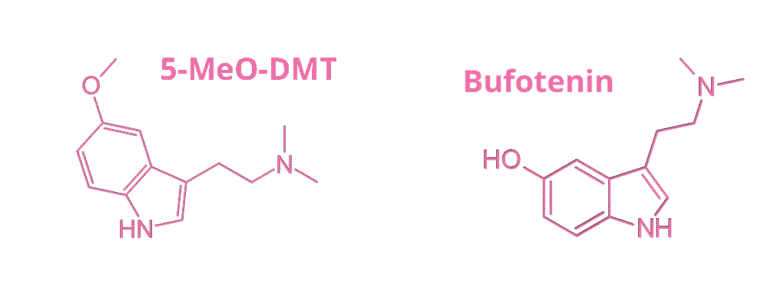
What remains after this process is mainly 5-MeO-DMT and bufotenine, two chemical compounds that share similarities with DMT. Both are potent psychedelics, being several times more potent than DMT, so much smaller doses are required to produce the same effect.
Although little research has been done on bufotenin, we know more about 5-MeO-DMT. Like DMT and other classic psychedelics, 5-MeO-DMT acts on serotonin receptors, especially the 5-HT2A receptor. The increase in serotonin caused by 5-MeO-DMT is thought to be related to its psychedelic effects.
Effects
What happens under the effect of ayahuasca is difficult to put into words, as the experience is unique and different for each person. Still, speaking very broadly, we can summarise some common threads in a typical ayahuasca experience.
The effects it produces are profound and can be transformative, but they can also be intense and challenging.
When drinking ayahuasca, it is possible to experience a change of perception of the world around you. Colours may seem brighter, sounds more intense and patterns more complex. You may also feel more connected to nature and to other human beings.
As the medicine begins to work, you may experience visions and intense emotional sensations. You may feel immersed in a spiral of thoughts and feelings, which can be overwhelming at first.
It is also possible to experience nausea and vomiting during the trip. One way of thinking about this process is that ayahuasca itself is not necessarily something that the body rejects, but that it is something that enters and flows throughout your being looking for negative energy and toxicity to expel, so the purge is seen as a way of eliminating rubbish from the system.
In rare cases, the effects of ayahuasca can be minimal and cause only mild nausea.
Purging ayahuasca is not something to worry about, as it is a key point of the drink for the indigenous people who use it in their rituals. According to them, only after purging can barriers at deep levels of the being be unblocked and allow the ayahuasca to do its work properly. Although it may seem daunting, purging finally relieves the feeling of nausea and is seen as a form of liberation and cleansing.
Finally, it is possible to have a sense of connection with a higher force, be it a deity or a universal energy. This can be a deeply spiritual experience that helps to find meaning and purpose in life.
Potential benefits
The potential benefits of drinking ayahuasca seem to far outweigh the risks.
In addition to anecdotal reports of spiritual development, ayahuasca is increasingly being considered as a potential therapeutic substance in the scientific community. Preliminary studies suggest that it may be effective in the treatment of mental illnesses such as addiction, anxiety and depression, which has given it a wider reputation as a psychological cure, and this has been empirically confirmed.
General well-being and health
Some people think that you can only take ayahuasca when you have mental problems. But there are many people who take it without suffering from mental problems, as it can be of great help for personal growth and the spiritual path of healthy people.
By providing deep insight and perspectives on difficult questions to answer, such as life choices and blocks to creativity, ayahuasca seems to dissolve problematic patterns of emotional behaviour that can lead to self-destructive thoughts and actions.
In fact, recent studies suggest that ayahuasca increases our ability to think divergently and decreases convergent thinking, which makes us step out of our "mental box" and consider different perspectives. In addition, it stimulates the growth of new brain cells and reduces internal reactivity, which changes the way we perceive and react.
Although the ayahuasca experience can be very profound and enlightening, its true value is only achieved with deep personal reflection and proper respect and "integration".
Ayahuasca is not only a remedy, but also a spirit and a way of life for many. Representing a major paradigm shift in the understanding of illness, wellness and human flourishing, ayahuasca seems to play a key role on the path to healing and personal growth.
Health and risks
Studies in both animals and healthy humans have shown that ayahuasca can be safe both physically and psychologically when its composition is known and it is administered in controlled doses and in appropriate environments with the necessary support.
However, it is important to note that there are risks associated with ayahuasca use that should be considered before deciding to use it. These risks can be physical due to the pharmacology of the substance and possible interactions, or psychological due to the nature of the experience that ayahuasca can generate.
People with severe mental health disorders, such as schizophrenia or bipolar disorder, should avoid ayahuasca as it can trigger latent psychosis in those with a personal or family history of psychosis. The most incompatible drugs are usually antidepressants. Recreational drugs should also not be used before or after taking ayahuasca, especially stimulants.
It is also important to be careful if you are taking medication, and to inform the facilitator of your state of health.
Pre-take preparation
Preparing to consume ayahuasca involves following a series of steps in the days or weeks leading up to the ceremony. Basically, this process includes:
- Rest and care for mind, spirit and body through proper diet.
- Set and reinforce intentions for the ceremony.
- Prepare the necessary personal items for the ceremony.
- Carry out additional cleaning before the ceremony, if necessary.
In short, it is about allowing the experience to settle in the mind, reducing anxiety, preparing to surrender to the experience, and psyching oneself up for the integration that follows after the ceremony.
Diet
Although the term "Diet" may seem to refer only to food, in reality it is a complete regime of abstinence from all that is harmful to the body, mind and soul.
Generally, the Diet includes avoiding salt, red meat, sugar, alcohol, drugs and sex. These recommendations can also be extended to include any unhealthy, fatty, overripe, fermented, pickled, aged, preserved or processed foods, as well as those with high gluten or yeast content, chocolate with high cocoa content and coffee.
While most foods are safe to consume before the ceremony, there are some foods that should be avoided. Tyramine, a compound present in some foods and beverages such as sourdough bread, fermented dairy products, processed meats, some legumes, pickles, draft beer, cocoa and wine, can interact negatively with ayahuasca. If tyramine-containing foods are consumed, the monoamine oxidase inhibitors (MAOIs) present in the Banisteriopsis caapi vine can cause adverse reactions such as palpitations, nausea and headaches. It is therefore recommended to follow the Diet at least a few days before and after the ceremony.
In addition to avoiding alcohol, drugs and tyramine-rich foods, other recommendations of the Diet, such as reducing stress and distractions, focusing on intentions, and abstaining from sex and masturbation, serve to achieve an optimal energetic state for the ceremony, rather than protecting against health risks. These guidelines provide tranquillity, physical freshness, mental clarity and concentration, which help spiritual pursuits to succeed. People with cardiovascular disease or psychosis are strongly advised to avoid drinking ayahuasca, and those taking chronic medication are strongly advised to discontinue the medication days or weeks before the ceremony, depending on the permanence of the active ingredient in the body.
Intention
It is essential that you set a clear intention before taking ayahuasca. Knowing your state of mind and personal situation, and having an idea of what you want to learn, can be very beneficial. The people of the Amazon consider ayahuasca to be "the master plant". If you enter into the experience without an intention, you may end up with no benefit. On the other hand, if you have an improper intention, such as simply wanting to get "high" as if it were just another drug, you could end up in a dark and negative place.
Your intention does not need to be impressive, it should simply be sincere and meaningful to you. It should be a clear and personal statement or question that reflects your deepest desires. By taking ayahuasca, you have the opportunity to connect with a deep inner wisdom. By setting a pure and honest intention, you are opening the door to receive authentic and meaningful insight.
 English
  Spanish